In Episode 1, we established that the foundation of fat loss is energy balance — calories in versus calories out. Now comes the practical question: how do you actually find out how many calories you need?
Most people have tried a calorie calculator at some point. They plug in their age, height, weight, and activity level, get a number, and try to follow it. Some see results. Most don't. Not because calorie calculators are useless — they're a solid starting point — but because almost everyone makes the same mistake when using them.
The DietSync Fitness App has a built-in calorie calculator that does this for you automatically. But before you use any calculator — including ours — it is worth understanding exactly how they work and where the most common mistake happens. Because entering the wrong input gives you a wrong output, no matter how accurate the formula is.
This episode is about understanding how these calculators actually work, where they go wrong, and how to get a number that genuinely fits your life.
In short
- To lose 1 kg of body fat you need a total calorie deficit of about 7,700 kcal.
- At 500 kcal a day below your TDEE that is 3,500 kcal a week: about 0.45 kg of fat a week, so a kilo every two weeks or so.
- Your TDEE is your BMR times your activity level. With a desk job and 3–4 gym sessions a week you are usually “lightly active” (× 1.375), not “very active”.
- Aim for a 300–500 kcal daily deficit, protein at 1.8–2.2 g per kg, fat at 0.8–1 g per kg, and carbs for the rest.

The Two Numbers Behind Every Calorie Calculator
Every calorie calculator is doing the same thing under the hood. It is calculating two figures and combining them.
BMR — Basal Metabolic Rate
This is the number of calories your body burns at complete rest. If you lay in bed and did nothing for 24 hours, you would still burn this many calories just to stay alive — running your heart, breathing, maintaining body temperature, keeping cells functioning.
The most widely used formula for calculating BMR is the Mifflin-St Jeor equation:
- Men: BMR = (10 × weight in kg) + (6.25 × height in cm) − (5 × age) + 5
- Women: BMR = (10 × weight in kg) + (6.25 × height in cm) − (5 × age) − 161
For an 80kg, 187cm, 25-year-old man, this gives roughly 1,850 kcal. For a 65kg, 172cm, 28-year-old woman, this gives roughly 1,423 kcal.
TDEE — Total Daily Energy Expenditure
This is your BMR multiplied by an activity factor to account for how much you actually move throughout the day. This is where the number becomes your real-world calorie target — and where most people go wrong.
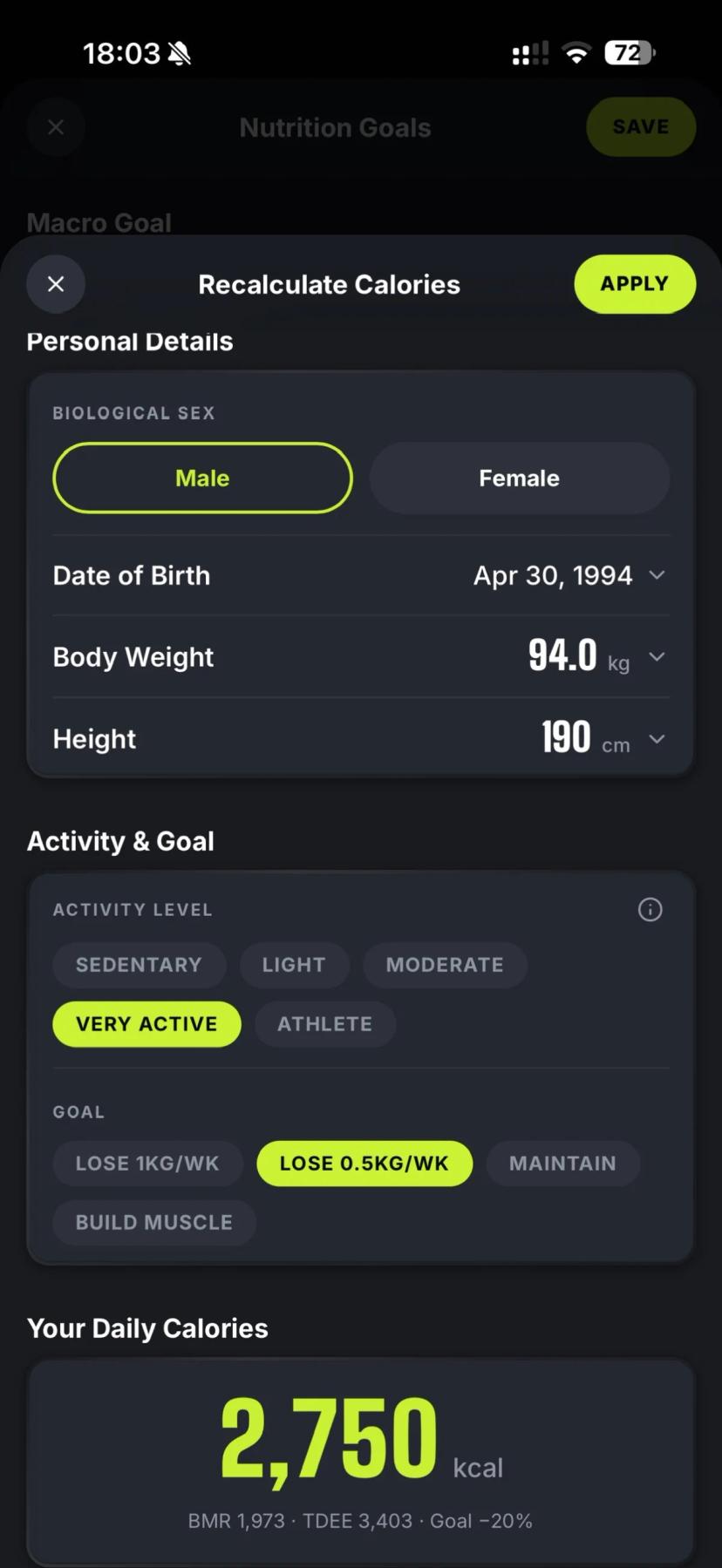
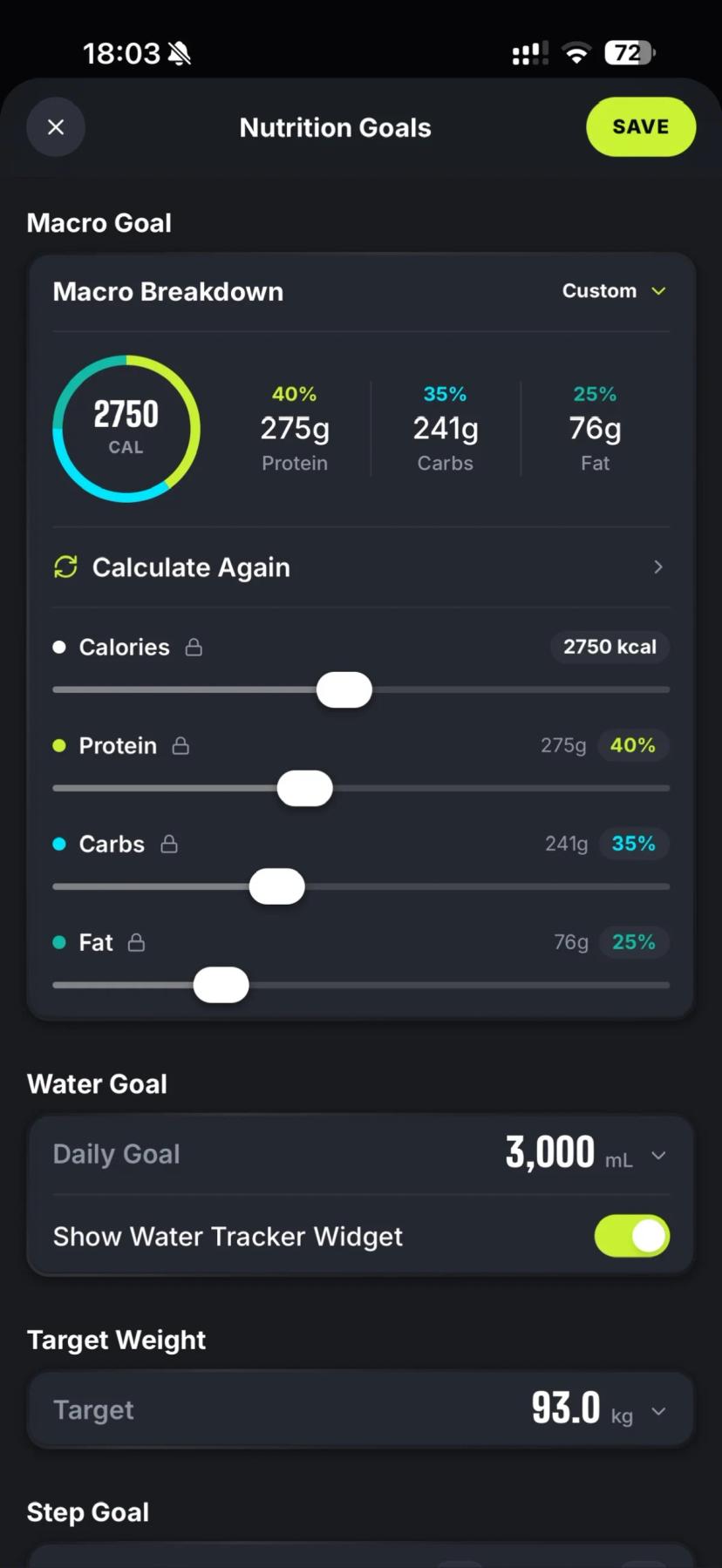
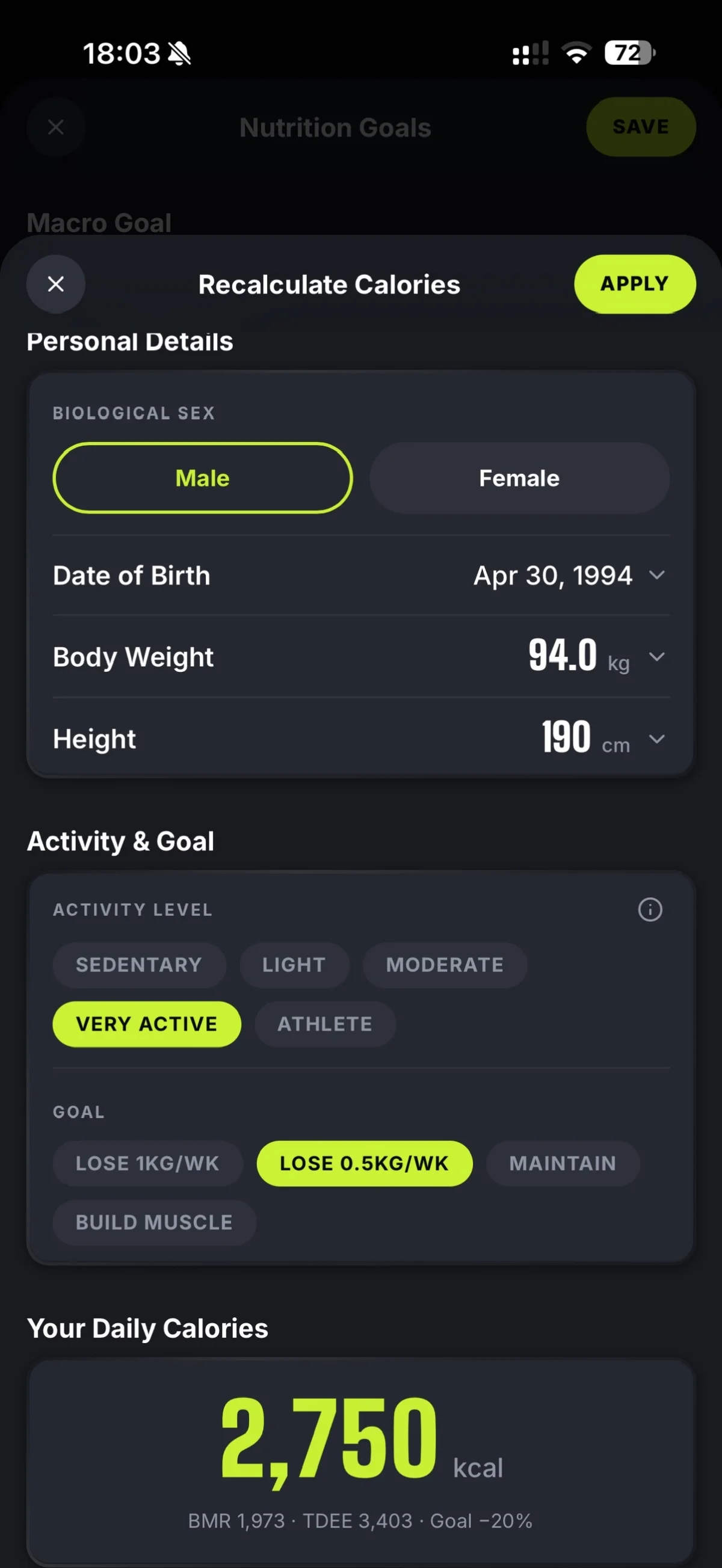
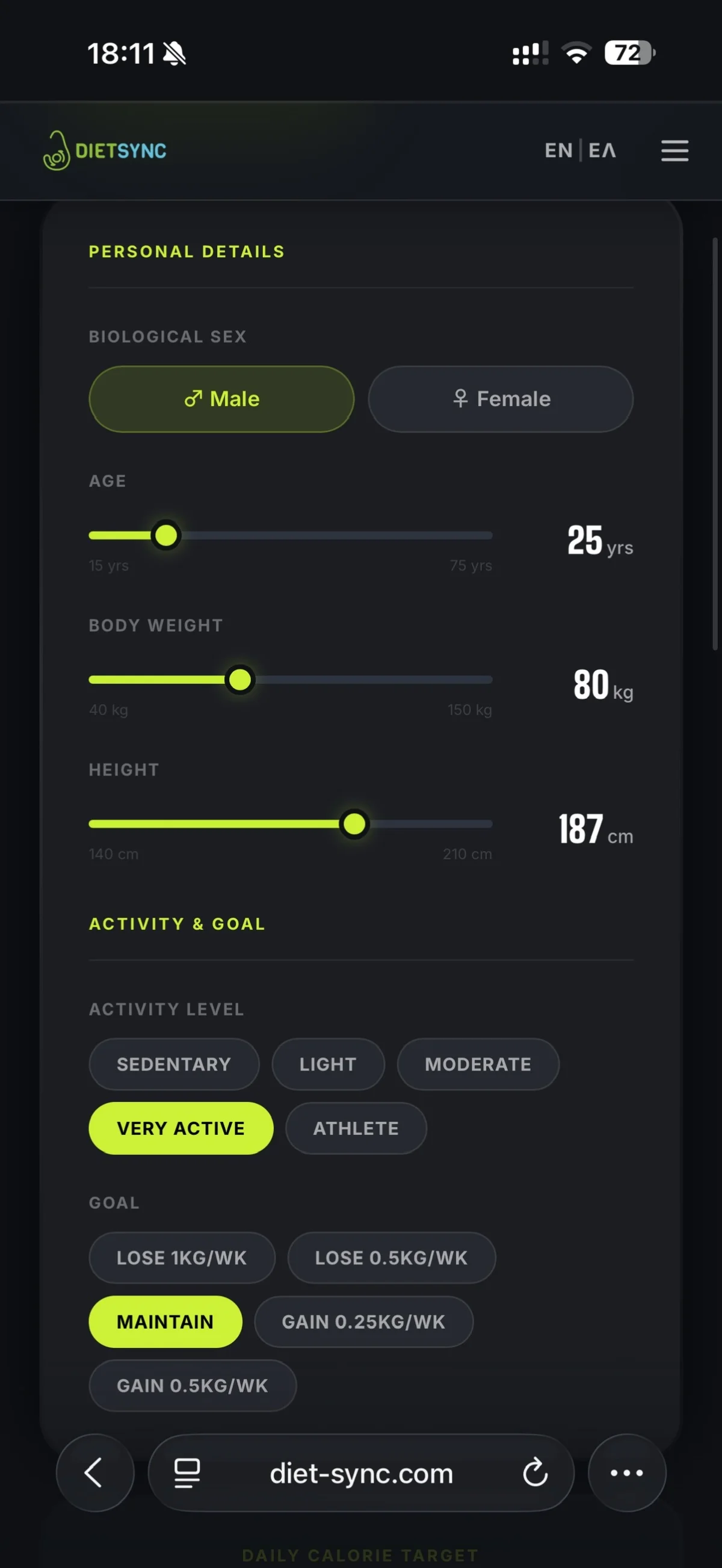
- Enter your weight, height, date of birth, activity level and goal
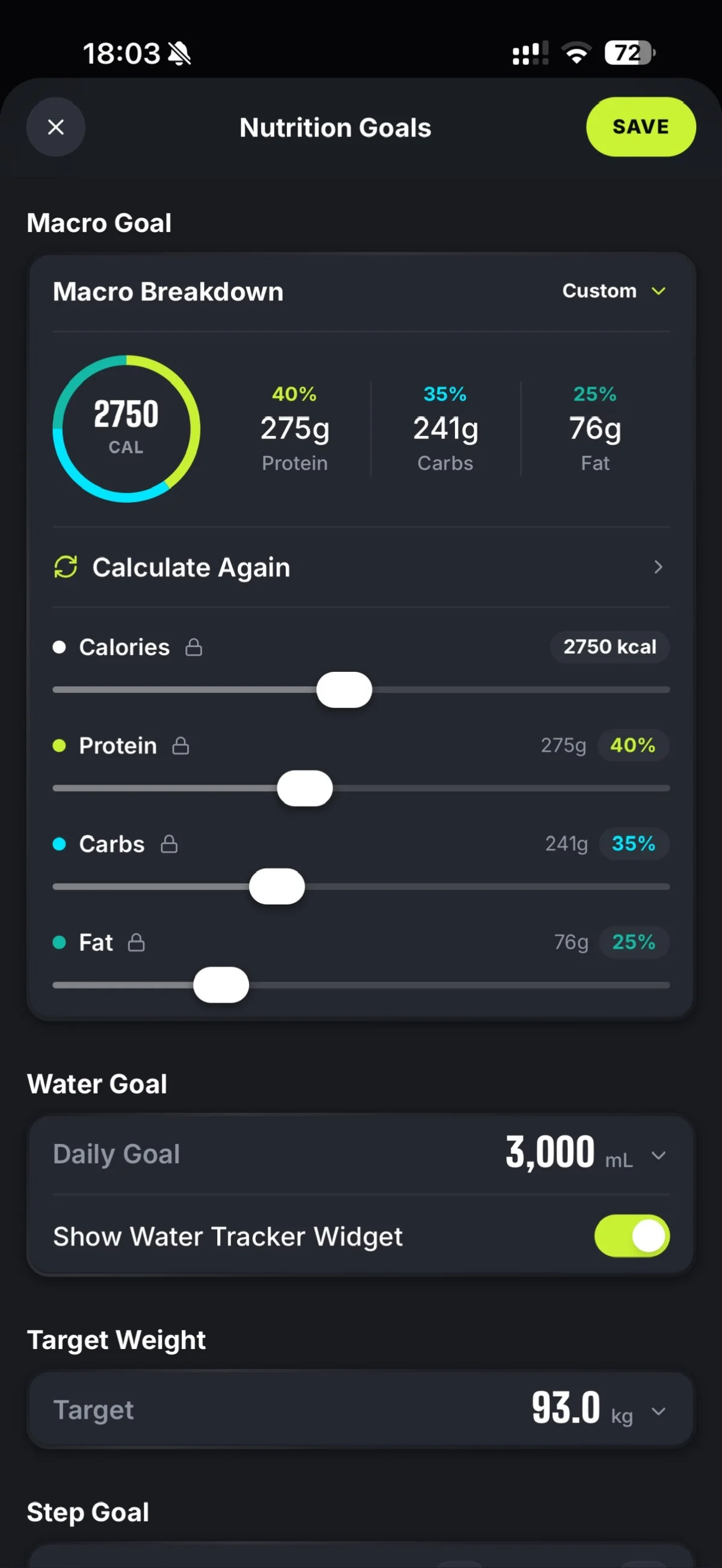
- Get a daily calorie target with protein, carbs and fat
- Pick your activity level honestly: it changes the number
The Activity Multipliers — And Why People Always Pick the Wrong One
Every calorie calculator gives you a list of activity levels to choose from. This is what they typically look like:
| Activity Level | Multiplier | What it Actually Means |
|---|---|---|
| Sedentary | 1.2 | Desk job, no structured exercise, minimal movement |
| Lightly Active | 1.375 | Desk job + light exercise 1-3 days/week OR standing job with no exercise |
| Moderately Active | 1.55 | Moderate exercise 3-5 days/week + some daily movement |
| Very Active | 1.725 | Hard exercise 6-7 days/week OR physically demanding job |
| Extra Active | 1.9 | Twice daily training OR extremely physical job (construction, athlete) |
This looks straightforward. In practice, it is one of the most consistently misapplied parts of the entire process.
Why Almost Everyone Overestimates Their Activity Level
Here is the honest picture of what most gym-goers actually look like when you break down their day:
- Wake up, commute to work — seated
- Sit at a desk for 7-8 hours
- Commute home — seated
- Go to the gym for 45-60 minutes
- Sit on the sofa for the evening
That is a real, very common day for someone who considers themselves "active." And yet when they open a calorie calculator, they typically choose "moderately active" or even "very active" because they feel like they train hard.
The reality: Someone with a desk job who goes to the gym 4 times a week is, at best, lightly active when their full 24-hour day is taken into account. The gym workout is 45-60 minutes out of 1,440 minutes in a day. The other 23+ hours matter just as much.
Let's see what this looks like in real numbers.
Example 1 — 80kg Male, desk job, gym 4x per week
- BMR: ~1,850 kcal
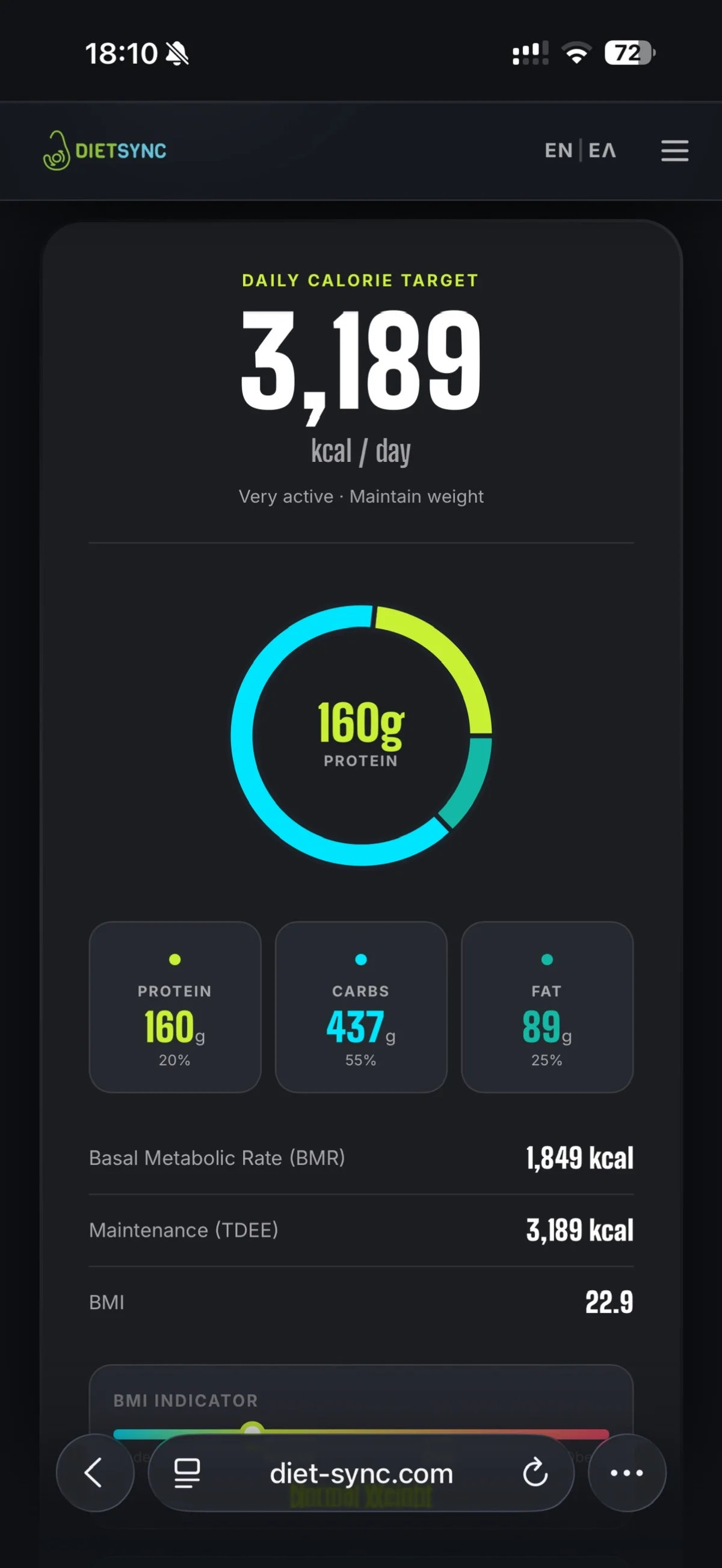
- He chooses "Very Active" (1.725): TDEE = 3,189 kcal
- Correct level is "Lightly Active" (1.375): TDEE = 2,544 kcal
- Difference: 645 kcal
If he eats at what he thinks is a 500 kcal deficit from 3,189, he is actually eating at a 145 kcal surplus. He will gain weight while genuinely believing he is in a deficit. This is one of the most common reasons people plateau before they even start.
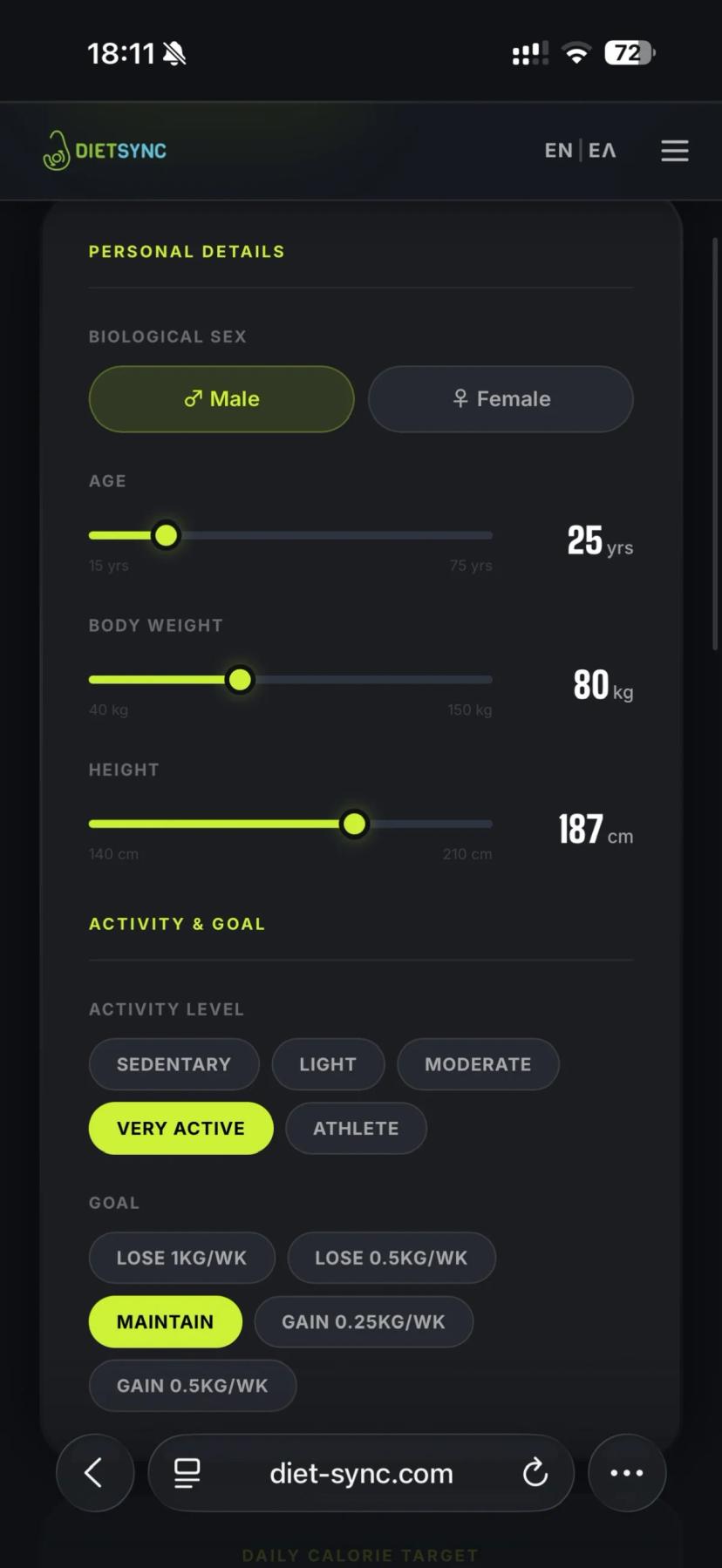
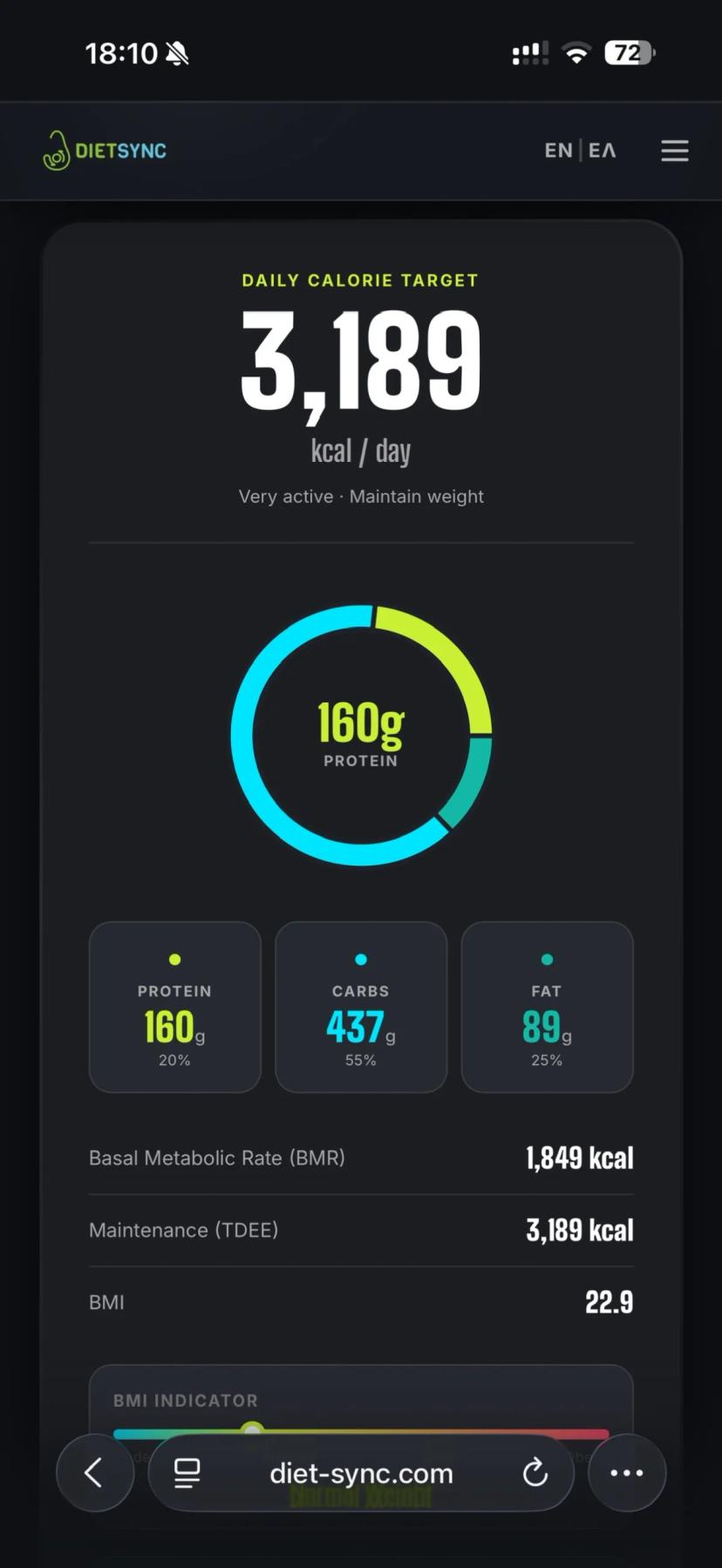
- 80 kg, 187 cm, 25 years old: BMR 1,849 kcal
- “Very active” gives 3,189 kcal a day
- “Lightly active” gives about 2,540 kcal: 645 kcal less
Example 2 — 65kg Female, desk job, gym 3x per week
- BMR: ~1,423 kcal
- She chooses "Moderately Active" (1.55): TDEE = 2,206 kcal
- Correct level is "Lightly Active" (1.375): TDEE = 1,957 kcal
- Difference: 249 kcal
That 249 kcal gap is almost a full extra snack every single day. Over a week, it is nearly 1,750 kcal — about a quarter of a kilogram of fat (0.23 kg) every week that should have been lost but wasn't.
The Step Count Reality Check
A useful way to calibrate your activity level honestly is to look at your daily step count. General guidelines suggest:
- Under 5,000 steps/day: sedentary to lightly active
- 5,000-7,500 steps/day: lightly active
- 7,500-10,000 steps/day: moderately active
- Over 10,000 steps/day: active
Most desk workers, when they actually check, are in the 3,000-6,000 range on non-gym days. That tells you something important about where the multiplier should sit.
Setting the Right Deficit
Once you have an honest TDEE, the deficit target is simple:
Aim for 300-500 kcal below your TDEE.
This range is the sweet spot for sustainable fat loss. A 500 kcal daily deficit is 3,500 kcal a week, which in theory is about 0.45kg of fat (3,500 ÷ 7,700). In the real world, with water fluctuation and daily variation, aim for 0.3-0.7kg per week as your target range.
How Many Calories to Lose 1 kg of Fat?
One kilogram of body fat holds about 7,700 kcal. Divide it by your weekly deficit and you know how long a kilo takes:
| Daily deficit | Weekly deficit | Fat lost per week | Time per kg |
|---|---|---|---|
| 250 kcal | 1,750 kcal | about 0.23 kg | about 4.5 weeks |
| 300 kcal | 2,100 kcal | about 0.27 kg | about 3.5 weeks |
| 400 kcal | 2,800 kcal | about 0.36 kg | about 2.5 weeks |
| 500 kcal | 3,500 kcal | about 0.45 kg | about 2 weeks |
Going deeper than 500 kcal is not more effective — it increases muscle loss risk, tanks energy levels, and is much harder to sustain.
Setting Your Macros
Once your calorie target is set, the macro split follows a logical order.
Step 1 — Set protein first Aim for 1.8-2.2g of protein per kg of bodyweight. For an 80kg male, that is 144-176g of protein, or roughly 580-704 kcal.
Protein is non-negotiable during cutting. It preserves muscle mass while the body is in a deficit and has the highest satiety per calorie of any macronutrient.
Step 2 — Set fats Minimum 0.8-1g per kg bodyweight, or roughly 20-25% of total calories. For an 80kg male at 2,044 kcal, that is approximately 45-55g of fat (405-495 kcal).
Do not drop fats lower than this. Chronically low fat intake disrupts hormone production, particularly testosterone and estrogen.
Step 3 — Fill the rest with carbs Whatever calories remain after protein and fat are accounted for go to carbohydrates. Carbs are the flexible macro — they go up when calories go up and down when calories go down.
Full Example — 80kg Male at 2,044 kcal
| Macro | Grams | Calories |
|---|---|---|
| Protein | 175g | 700 kcal |
| Fat | 50g | 450 kcal |
| Carbs | 224g | 894 kcal |
| Total | 2,044 kcal |
Full Example — 65kg Female at 1,457 kcal
| Macro | Grams | Calories |
|---|---|---|
| Protein | 130g | 520 kcal |
| Fat | 42g | 378 kcal |
| Carbs | 140g | 559 kcal |
| Total | 1,457 kcal |
The Problem With Treating TDEE as Fixed
One last thing worth understanding: your TDEE is not a permanent number. As your weight drops, your BMR drops too — because a lighter body requires fewer calories to maintain. This is one of the reasons fat loss slows down over time even if nothing changes in the diet.
It is also why the first-week protocol covered in Episode 3 matters so much. Your TDEE calculation is a hypothesis, not a fact. The scale tells you whether it is accurate — and if it does not move, the number needs to be adjusted.
Your favourite foods can still fit. A homemade Big Mac has 467 kcal and 49 g of protein, and a crispy chicken burger has 433 kcal and 46 g, so both sit comfortably inside a fat-loss day.
Use the DietSync Calorie Calculator
Rather than doing all of this manually, the DietSync Fitness App has a built-in calorie and macro calculator that does everything covered in this article for you.
You enter your weight, height, age, goal and activity level, and DietSync works out your daily calorie target with your protein, carb and fat targets. Then you log your weight and see your trend over time: the Weight Tracker shows your weekly averages for the last six weeks, and the Progress card shows your pace in kg a week. If your weekly average hasn’t moved after two full weeks, change your calories in Goals and your new plan starts the same day. With a coach (Premium and Ultimate), your coach sees when your weight hasn’t moved in two weeks and adjusts your target with you.
The difference between DietSync and a generic online calculator: a calculator gives you a number and leaves you alone. In DietSync you log your food and your weight in the same app, so you can see whether the number is working and change it when your weight changes.
You can download the DietSync Fitness App from the App Store or Google Play.
QUESTIONS
Frequently asked questions
How many calories do I need to burn to lose 1 kg of fat?
About 7,700 kcal. That is the total deficit, spread over days or weeks: at 500 kcal a day below your TDEE it takes a little over two weeks, at 300 kcal a day about three and a half.
How much weight will I lose with a 500 calorie deficit?
About 3,500 kcal a week, which is roughly 0.45 kg of fat a week. Water and food in your gut move the scale up and down, so judge it by your weekly average weight, not one weigh-in.
How do I calculate calories for fat loss accurately?
Work out your BMR (Mifflin-St Jeor), multiply it by an honest activity level (usually “lightly active” for desk workers who train) and take 300–500 kcal off. Then check your weekly average weight for two weeks and adjust.
What is a safe calorie deficit for weight loss?
300–500 kcal below your TDEE. It gives a sustainable 0.3–0.7 kg a week while protecting muscle. Going deeper raises the risk of losing muscle and is harder to stick to.
Why am I not losing weight in a calorie deficit?
Most often the deficit isn’t real: the activity level was set too high (one hour in the gym, 23 hours sitting), or food isn’t tracked accurately. Check your weekly average for two weeks before you change anything.
How much protein do I need when cutting?
1.8–2.2 g per kg of bodyweight. For an 80 kg man that is 144–176 g a day. Set protein first, then fat, then fill the rest with carbs.